What Are Incoterms?
Incoterms (International Commercial Terms) are a standardised set of trade terms published by the International Chamber of Commerce. They define the responsibilities of buyers and sellers in international transactions — specifically who arranges and pays for transportation, insurance, and customs clearance, and at what point the risk of loss transfers from seller to buyer. Always specify the Incoterm version in your contract, e.g., “FOB Shanghai Incoterms 2020”.
FOB — Free On Board
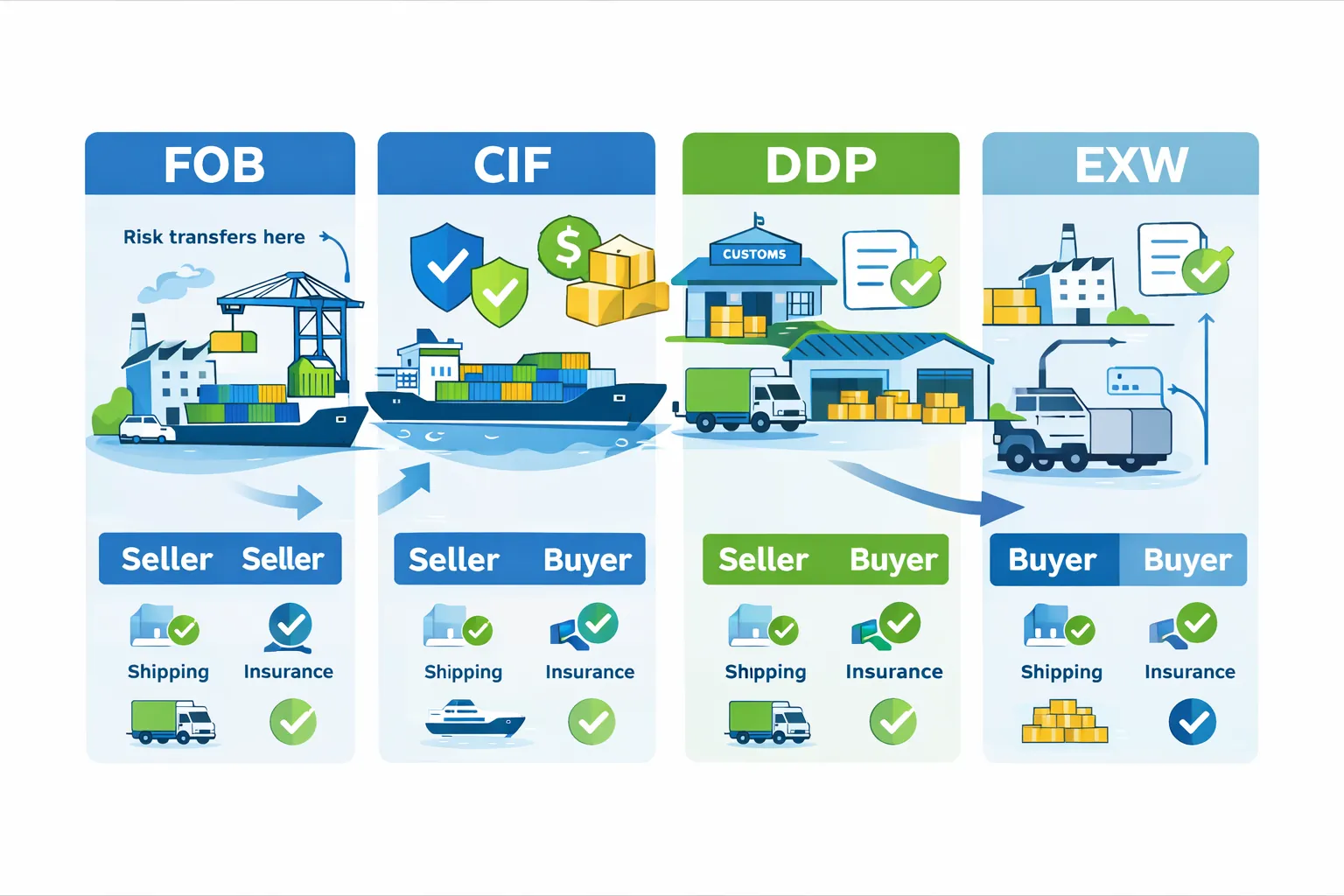
FOB is the most commonly used Incoterm in China sourcing. Under FOB, the seller (Chinese factory) handles export customs and delivers the goods on board the vessel at the named Chinese port. Once the goods are on the ship, risk transfers to the buyer. The buyer arranges and pays for the main ocean or air freight, marine insurance, and import customs at the destination.
- Seller responsible: export clearance and delivery to vessel at Chinese port
- Buyer responsible: main freight, insurance, and import customs
- Risk transfers when goods are loaded onto the vessel
- Most popular Incoterm for Amazon FBA and ecommerce sourcing
CIF — Cost, Insurance, Freight
Under CIF, the seller pays for the main freight and insurance to the named destination port. However — importantly — risk still transfers to the buyer when goods are loaded onto the vessel at the origin port, not at the destination. The buyer handles import customs and duties at the destination. CIF is only applicable to sea and inland waterway transport.
- Seller responsible: main freight cost and marine insurance to destination port
- Buyer responsible: import customs, duties, and onward delivery
- Risk transfers at origin port — not destination
- Verify the insurance coverage amount meets your requirements
DDP — Delivered Duty Paid
DDP represents maximum responsibility for the seller. Under DDP, the seller handles everything — shipping, export clearance, import customs, and even pays import duties and VAT in the buyer’s country. The buyer receives goods fully cleared and delivered to the named destination. DDP is convenient but typically results in a higher quoted price, as the seller builds all costs into the unit price.
- Seller responsible: all shipping, customs, duties, and final delivery
- Buyer responsible: unloading goods at destination
- Risk transfers at delivery point in buyer’s country
- Higher unit price but no surprise charges on arrival
EXW — Ex Works
EXW places almost all responsibility on the buyer. The seller simply makes goods available at their factory or warehouse. The buyer arranges collection, export customs, main freight, insurance, import customs, and all onward logistics. EXW is rarely practical for overseas buyers without a local freight agent in China.
- Seller responsible: making goods available at factory
- Buyer responsible: everything from factory pickup onward
- Buyer needs a local agent in China for export clearance
- Not recommended for first-time importers without logistics support
Choosing the Right Incoterm
For most ecommerce sellers sourcing from China, FOB is the most practical and widely accepted term. It gives you control over freight costs and carrier selection, while the factory handles export documentation. If you have a reliable freight forwarder, use FOB. If you want a fully managed, all-inclusive price, negotiate DDP with a trusted supplier.
- FOB: most practical for ecommerce sellers with a freight forwarder
- CIF: consider if you want the supplier to arrange main transport
- DDP: best for convenience — but verify the all-in price is competitive
- EXW: only suitable if you have a reliable local agent in China
Get a free quote within 24 hours. No commitment, no hidden fees.
Need help sourcing products from China?
Contact Saeed Global Services for a free sourcing consultation. We handle supplier verification, price negotiation, quality inspection and shipping — end to end.