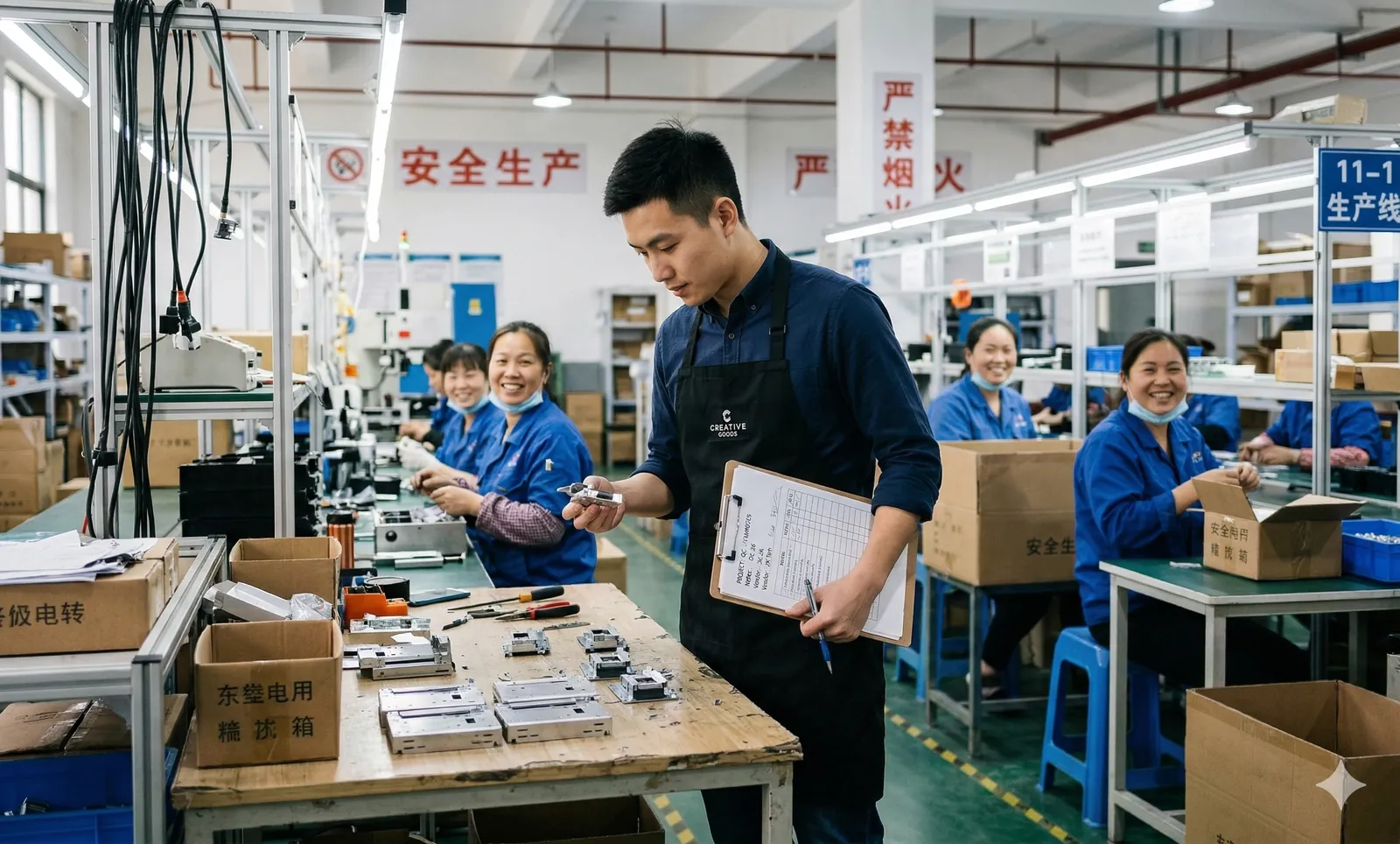
Market Research
Begin by identifying a product with strong demand and healthy profit margins. Use tools like Google Trends and Amazon Best Seller lists to spot trending items. Calculate your expected margin by accounting for all costs — manufacturing, shipping, FBA fees, and customs duties — before committing.
The first mistake beginners make is choosing a product because it looks popular, then discovering too late that the landed cost leaves no room for advertising, returns, storage, or price competition. Demand is only useful if the product can survive the full cost chain from Chinese factory to your customer. Treat market research as a rejection process: your job is to remove weak ideas before you spend money on samples, moulds, packaging, or freight.
- Use Google Trends and Amazon BSR lists to validate demand
- Calculate full landed cost including duties and shipping
- Focus on products with high demand and sustainable margins
- Avoid highly regulated categories for your first order
A workable first product is usually simple to inspect, not fragile, not liquid, not battery-powered, not a children’s product, and not dependent on complex certifications. That does not mean those categories are impossible. It means they add more ways for a beginner to lose money through failed testing, customs holds, Amazon compliance requests, or returns caused by small quality differences.
Start with a simple demand check. Look at whether search interest is stable or seasonal, whether the product is dominated by established brands, and whether listings in your target marketplace have enough review depth to prove sales but not so much that a new seller cannot compete. Google Trends can show seasonality, while marketplace bestseller lists can show what customers already buy. Neither tool proves profitability by itself.
| Research question | What to check | Practical decision | Common failure |
|---|---|---|---|
| Is demand real | Search trend, bestseller rank, review volume | Continue only if demand is visible across more than one signal | Buying a product after one viral video |
| Can it be inspected | Dimensions, material, finish, function | Choose products with clear pass or fail criteria | Approving vague samples that factories cannot repeat |
| Can it be imported | HS code, duty, restricted materials, safety rules | Verify compliance before paying a deposit | Discovering certification issues after production |
| Can it make margin | Unit cost, packing, freight, duty, platform fees | Reject if profit depends on perfect assumptions | Ignoring storage, returns, and advertising cost |
Use a landed cost worksheet before contacting suppliers. For example, if a factory quotes a unit price, do not treat that as your product cost. Add export carton packaging, inspection, inland transport in China if it is not included, international freight, customs duty, customs brokerage, local delivery, Amazon or fulfilment fees, and any relabelling or prep. If one line is unknown, write [VERIFY: exact cost needed] instead of filling the gap with a guess.
A simple first-order calculation can look like this: factory unit price, plus estimated freight per unit, plus duty under the correct HS code, plus fulfilment fees, plus a reserve for defects and returns. If the product only looks profitable when you assume the lowest possible freight cost and no defects, it is not a safe first sourcing project. Build the numbers conservatively before you ask a factory to reserve capacity.
Finding Suppliers
Browse B2B platforms such as Alibaba or Global Sources to find verified manufacturers. Filter by Gold Supplier and Trade Assurance status to prioritize vetted sellers. Attending trade fairs like the Canton Fair lets you meet suppliers face-to-face and inspect samples directly. If you prefer support, a sourcing agent can connect you with pre-vetted factories and handle language differences on your behalf.
The supplier you choose determines your real product, not the listing photo. Many beginners compare only the quoted unit price, but factories can reduce price by changing material thickness, using cheaper accessories, lowering packaging quality, or moving production to a subcontractor. Your shortlist should be based on product fit, factory capability, communication quality, compliance experience, and willingness to document specifications.
- Search Alibaba and Global Sources with precise keywords
- Filter for Gold Supplier and Trade Assurance badges
- Consider attending the Canton Fair for direct supplier contact
- Use a sourcing agent to overcome language barriers and vet factories
Badges and platform filters are useful for screening, but they are not a substitute for due diligence. A supplier may be a trading company, a factory, or a factory-owned sales office. None of those is automatically bad. A trading company can be useful for small mixed orders, while a manufacturer may be better for stable production and customisation. The problem is not the category; the problem is not knowing who is actually making the goods.
When searching, use product-specific terms, material terms, and manufacturing process terms. Instead of only searching “water bottle,” search for the material, capacity, lid type, finish, and certification needed in your destination market. Save screenshots and links for every supplier you contact, because listings change and sales staff move between companies. If you need hands-on supplier shortlisting, Saeed Global Services can support the process as a China sourcing agent and verify whether the supplier fits your order, not just whether the online profile looks acceptable.
| Supplier route | Best for | Main advantage | Main risk |
|---|---|---|---|
| Alibaba | First supplier shortlist | Large supplier pool and fast quotations | Listings can look similar while factories differ greatly |
| Global Sources | Electronics, gifts, home, lifestyle products | Useful for comparing exporters and product lines | Still requires independent checking |
| Canton Fair | Buyers who can travel and inspect samples | Face-to-face discussion and visible product range | Travel cost and limited time to compare options |
| Sourcing agent | Buyers who need local verification and follow-up | Factory checks, negotiation support, production monitoring | Agent quality varies, so scope must be clear |
Ask each supplier direct questions that prove capability. Can they make the product to your target material? Have they exported the same category to your country? Can they provide test reports that match the exact product and factory, not a different model? Can they accept third-party inspection before shipment? A serious supplier will answer with specific documents and limits; a weak supplier will reply with “no problem” to everything.
For Alibaba specifically, do not rely only on the cheapest search result. Compare company age, product focus, factory videos, transaction history where visible, certificate names, and how clearly the sales person understands technical questions. If you want help turning Alibaba search results into a usable shortlist, our Alibaba sourcing agent work focuses on checking the supplier behind the listing before you commit to a deposit.
Contact and Negotiate
Reach out to several shortlisted suppliers and request detailed product specifications — materials, dimensions, certifications. Ask for quotations from multiple suppliers so you can compare pricing, MOQs, and lead times. Negotiate on order quantity and payment terms to secure the best deal. The standard payment structure in China sourcing is 30% deposit before production begins and 70% balance before shipment.
Request specifications from at least 3 suppliers simultaneously. This is not only for price comparison. It shows whether suppliers understand your product, whether they ask useful questions, and whether their quotation contains enough detail to become a purchase order. If one supplier quotes far below the others, investigate the difference before treating it as a saving.
- Request specifications from at least 3 suppliers simultaneously
- Compare unit cost, MOQ, lead time, and certification status
- Negotiate payment terms — standard is 30% deposit / 70% balance
- Never agree to 100% prepayment from an unknown supplier
Your first message should be short but specific. Include the product type, target quantity, destination country, required material, packaging style, target compliance requirements, whether the goods are for Amazon FBA or another channel, and whether you need private label packaging. Do not send only “best price?” because the supplier will quote the easiest version of the product, not necessarily the version you need.
Use a quotation comparison sheet. Separate the product price from mould fees, sample fees, packaging fees, inland freight, export charges, and bank charges. Ask which Incoterm the quote uses. EXW, FOB, CIF, DAP, and DDP place different costs and risks on the buyer and seller. The International Chamber of Commerce publishes Incoterms rules; use them carefully because a small misunderstanding can move responsibility for customs, freight, or insurance to the wrong party.
| Quote item | Supplier A | Supplier B | Decision point |
|---|---|---|---|
| Unit price | [VERIFY] | [VERIFY] | Compare only after specs are identical |
| MOQ | [VERIFY] | [VERIFY] | Check whether small MOQ changes affect price |
| Lead time | [VERIFY] | [VERIFY] | Confirm whether it starts after deposit or sample approval |
| Incoterm | [VERIFY] | [VERIFY] | Make sure freight responsibility is clear |
| Certification | [VERIFY] | [VERIFY] | Match reports to product, factory, and destination market |
Negotiate the parts that matter most for a first order. Price is one part, but payment safety, inspection rights, defect remedy, spare parts, packaging protection, and delivery timing often matter more. A factory that refuses written specifications, refuses inspection, or asks for 100% prepayment from an unknown buyer is creating risk you do not need on your first order.
Put all agreed details into a purchase order or pro forma invoice before sending the deposit. The document should include product name, SKU, material, colour, dimensions, tolerance if relevant, logo placement, packaging, carton marks, inspection standard, payment terms, Incoterm, delivery date, bank account details, and what happens if inspection fails. Confirm the bank account by a separate channel before payment, because email compromise and changed payment instructions are common fraud risks in international trade.
Samples and Quality Control
Never skip the sample step. Order pre-production samples from your shortlisted suppliers and inspect them carefully for material quality, dimensions, finish, and functionality. If your order volume is significant, schedule a factory inspection during production and a final pre-shipment inspection before goods leave the factory. Consistent quality control is the single most effective way to avoid defective shipments.
A sample is not a guarantee that mass production will match it. It is a reference point. The supplier may make a careful sample in a sample room, then mass production may be handled by different workers, different machines, or a subcontracted workshop. Your job is to convert the approved sample into written specifications and inspection checkpoints that the factory cannot reinterpret later.
- Order physical samples before committing to mass production
- Inspect materials, dimensions, finish, and packaging
- Schedule in-process and pre-shipment quality inspections for large orders
- Document all specifications in writing before production begins
When the sample arrives, do not only check whether it looks good. Measure it, weigh it, test the function repeatedly, check the surface under normal light, test packaging strength, and compare it with competitor products in the same price range. If the product touches food, skin, electricity, children, or medical use, compliance testing becomes part of the sourcing decision, not an afterthought.
Create a sample approval file. Include photos from all angles, measurements, packaging photos, logo artwork, colour references, material description, barcode requirements, and any defects you accepted or rejected. If you approve a sample with a minor defect, state clearly whether that defect is acceptable in mass production. Factories often treat silent acceptance as permission.
| QC stage | When it happens | What it catches | Buyer decision |
|---|---|---|---|
| Sample review | Before deposit or before mass production | Wrong material, finish, function, packaging concept | Approve, revise, or reject supplier |
| Factory audit | Before order or before repeat orders | Capacity issues, fake factory claims, weak process control | Proceed, reduce order, or find another supplier |
| During production inspection | After production has started | Early defects before the full batch is completed | Correct process before more goods are made |
| Pre-shipment inspection | When goods are finished and packed | Defects, quantity shortages, wrong cartons, wrong labels | Pay balance, rework, or hold shipment |
Pre-shipment inspection must happen before you pay the 70% balance and before goods leave the factory. Once goods are shipped, your leverage is much weaker. If the inspection fails, ask for a corrective action plan, photos of rework, and a re-inspection if the defect risk is material. Do not accept “we will improve next time” for defects in the order you have already paid for.
For ecommerce sellers, packaging quality is part of product quality. Thin cartons, weak tape, poor polybags, missing suffocation warnings where required, bad barcodes, and mixed SKUs can create warehouse problems even when the product itself is acceptable. If you need independent checks before shipment, Saeed Global Services provides China quality inspection support for samples, during-production checks, and final inspections.
Logistics and Shipping
Compare air and sea freight based on urgency, cost, and order weight. For large, non-urgent orders, sea freight is significantly cheaper — often 4–5x cheaper per kilogram than air. Work with a freight forwarder to handle export customs in China and ensure all shipping documents are correct. For Amazon FBA shipments, label each unit with the required FNSKU barcode and ensure packaging meets Amazon’s guidelines.
Logistics should be planned before production finishes, not after the cartons are ready. The shipping method affects carton size, packaging strength, cash flow, and launch timing. A first order often fails because the buyer sells the product in the spreadsheet but forgets the time and cost between factory completion and available inventory in the warehouse.
- Sea freight is 4–5x cheaper than air for large orders
- Use a freight forwarder for export customs and documentation
- Amazon FBA shipments require FNSKU labeling and specific packaging prep
- Plan 60–90 days of lead time for sea freight orders
Air freight is useful when the order is small, high value, urgent, or needed to prevent a stockout. Sea freight is usually the better option for larger non-urgent orders, but it requires more planning. The existing rule to plan 60–90 days of lead time for sea freight orders is practical because it covers production, inspection, booking, export handling, sailing, import clearance, and delivery to the final warehouse. Port congestion, customs exams, holiday closures, and missed vessel cut-offs can extend the timeline.
Before shipping, confirm the Incoterm, cargo ready date, carton count, carton dimensions, gross weight, net weight, HS code, commercial invoice, packing list, and consignee details. For the United States, United Kingdom, and EU, customs classification and product compliance are the importer’s responsibility even when a supplier or forwarder helps with paperwork. Ask your forwarder what they need early enough to correct errors before the vessel or flight is booked.
| Shipping option | Best use | Typical advantage | Main risk |
|---|---|---|---|
| Express courier | Samples and very small urgent shipments | Fast handling and simple tracking | High cost per unit |
| Air freight | Small or urgent commercial orders | Faster than sea freight | Cost can destroy margin on bulky goods |
| Sea freight LCL | Orders smaller than a full container | Lower cost than air for heavier cargo | More handling and possible delays at consolidation points |
| Sea freight FCL | Large orders filling a container | Better control and lower handling per unit | Requires more inventory cash and planning |
Amazon FBA adds another layer of rules. Each sellable unit must be scannable, and shipments must follow Amazon’s packaging, prep, and routing requirements. FNSKU labelling is common for private-label sellers because it identifies your inventory inside Amazon’s system. If carton labels are wrong, barcodes are unreadable, or case quantities do not match the shipping plan, receiving delays and extra fees can follow.
Decide early whether goods will go direct from China to Amazon, to a third-party prep centre, or to your own warehouse. Direct-to-FBA can save handling time but leaves little room to fix labelling, bundling, or quality problems after arrival. A prep centre gives you a correction point but adds time and cost. If Amazon is your sales channel, our Amazon FBA sourcing work includes supplier coordination, inspection planning, and FBA prep checks before the shipment leaves China.
Product Compliance and Import Documents
Compliance is where many first-time importers get surprised. A supplier saying “we export this product all the time” is not the same as proving the product is legal for your market and sales channel. Customs authorities, marketplace platforms, and local regulators may all ask for different documents, and the importer is usually responsible for making sure the product is classified, labelled, and documented correctly.
Start with the HS code. The Harmonized System is used internationally to classify traded goods, but duty rates and import requirements depend on the destination country’s tariff schedule and the exact product details. Do not let the supplier choose the HS code without review. Suppliers may choose a convenient code they used before, not the code your customs broker will accept.
- Confirm the HS code before calculating duty
- Match certificates to the exact product and factory
- Check destination market labelling before packaging is printed
- Keep commercial invoice and packing list details consistent
Documents for a standard shipment usually include a commercial invoice, packing list, bill of lading or air waybill, and any product-specific certificates or test reports. Depending on the product and country, you may also need declarations, safety data sheets, fumigation details for wooden packaging, origin documents, or marketplace compliance files. The correct answer depends on the product, material, usage, and destination, so this is an area where [VERIFY: destination-specific import requirement] is better than guessing.
| Document | Who prepares it | What to check | Failure mode |
|---|---|---|---|
| Commercial invoice | Supplier, reviewed by buyer or broker | Seller, buyer, description, value, currency, Incoterm | Customs delay from vague or inconsistent descriptions |
| Packing list | Supplier | Carton count, weights, dimensions, SKU quantities | Warehouse receiving mismatch |
| Bill of lading or air waybill | Forwarder or carrier | Consignee, shipper, port, marks, cargo description | Release problems at destination |
| Test report or certificate | Testing lab or supplier source document | Product model, factory name, standard, date, lab identity | Platform or customs rejection because report does not match |
Compliance also affects packaging. Country of origin marking, warning labels, recycling symbols, language requirements, and platform barcode rules should be checked before cartons and retail boxes are printed. Reprinting packaging after production is slow and expensive. Worse, shipping non-compliant packaging can lead to relabelling at destination, stock delays, or rejected inventory.
If you are unsure, ask a customs broker or compliance consultant in your destination country before production. A China-based supplier can provide documents, but they are not your legal representative in the United States, United Kingdom, or EU. Keep a folder for every SKU with the quotation, specification sheet, approved sample photos, purchase order, invoice, packing list, inspection report, test reports, and shipping documents.
Your First Order Workflow
A beginner should not treat China sourcing as one big decision. It is a sequence of smaller gates. At each gate, you either continue, correct the problem, or stop before more cash is at risk. This is how experienced importers avoid turning a small mistake into a container of unsellable stock.
The safest first order is usually not the biggest order the supplier will accept. It is the smallest order that still proves the product, supplier, packaging, inspection process, freight route, and sales channel. Once those are proven, repeat orders are easier to negotiate and control.
- Reject weak product ideas before paying for samples
- Shortlist suppliers with identical written specifications
- Approve samples before paying the production deposit
- Inspect finished goods before paying the balance
| Step | Buyer action | Decision gate | Do not proceed if |
|---|---|---|---|
| Product research | Check demand, competition, landed cost, compliance | Product is commercially viable | Margin depends on missing or optimistic costs |
| Supplier shortlist | Contact at least 3 suppliers with the same RFQ | Supplier can meet spec and document claims | Supplier avoids clear answers or refuses inspection |
| Sample approval | Test sample and record specifications | Sample matches your target product | Supplier cannot fix sample defects in writing |
| Production | Pay deposit under agreed terms and monitor progress | Goods are made to approved spec | Factory changes material, packaging, or schedule without approval |
| Shipment | Inspect, pay balance if passed, book freight | Documents, labels, cartons, and routing are correct | Inspection fails or shipping documents conflict |
The decision you have to make is how much control you want to run yourself. Some buyers contact factories, compare quotes, arrange samples, book inspections, and coordinate freight directly. Others use local support because the cost of a missed detail is higher than the service fee. Neither approach is automatically right. The correct choice depends on your product risk, order value, experience, and how much time you can spend managing the details.
If you are starting your first order, build the file before you build the product. Have a written RFQ, a comparison sheet, a sample approval record, a purchase order, an inspection checklist, and a freight plan. When those documents are clear, the supplier has less room to improvise. When they are missing, every discussion becomes a memory test between you and a salesperson working across time zones.
Saeed Global Services works with ecommerce importers that need practical help from supplier search through inspection and shipping coordination. If you want a managed process, review our sourcing process and prepare your product details, target market, quantity, and any competitor references before requesting support.
Frequently Asked Questions
how many suppliers should i contact when sourcing my first product from china
You should contact at least 3 suppliers for your first China sourcing project. This gives you a basic comparison on unit cost, MOQ, lead time, communication quality, and whether the supplier can document the product properly. If all suppliers answer differently, your RFQ is probably not specific enough yet.
what payment terms are normal for a first china sourcing order
The standard payment structure is 30% deposit before production begins and 70% balance before shipment. Do not pay 100% upfront to an unknown supplier, because you lose leverage if quality, timing, or documentation problems appear. The balance should be linked to finished goods, inspection, and correct shipping documents.
should i order samples before sourcing from china
Yes, you should order samples before mass production. A sample lets you check material, dimensions, finish, function, packaging, and whether the supplier understands your specification. The approved sample should be turned into a written specification so production can be inspected against it.
how long does sea freight take for a first order from china
You should plan 60–90 days of lead time for sea freight orders. That window should include production, inspection, booking, export handling, sailing, import clearance, and final delivery. Urgent or small shipments can use air freight, but the cost can damage margin on bulky goods.
what import compliance should i check before buying from china
You need to check HS code, customs duty, product safety rules, labelling, and any marketplace requirements before production. The supplier can provide documents, but the importer is responsible for correct classification and compliance in the destination country. If the product touches food, skin, electricity, children, or medical use, check compliance before paying a deposit.
Sources
- Google Trends Google
- Incoterms rules International Chamber of Commerce
- What is the Harmonized System? World Customs Organization
- Basic Importing and Exporting U.S. Customs and Border Protection
- Fulfillment by Amazon Amazon
Need help with any of these steps? Saeed Global Services handles supplier sourcing, quality inspection, and logistics coordination for ecommerce sellers. We respond to all enquiries within 24 hours.
Get a free quote within 24 hours. No commitment, no hidden fees.
Need help sourcing products from China?
Contact Saeed Global Services for a free sourcing consultation. We handle supplier verification, price negotiation, quality inspection and shipping — end to end.